Services

Mobile Application Penetration Test (VAPT)


Our mobile application penetration test proves what’s secure by testing code, storage, and transport for data leaks and exploitable API defects.

Mobile application VAPT for iOS and Android apps

Validate mobile defenses where business and users intersect

A Mobile Application Penetration Test (VAPT) is a structured security assessment of the app binary, the mobile client at runtime, and the backend API. It uses active exploitation to test how the application behaves on device and in transit. Unlike a web application penetration test, mobile app penetration testing examines client-side attack surfaces that server-side testing cannot reach. These include insecure data storage, inter-process communication, and certificate validation. It also tests how the mobile client communicates with backend services, and whether security controls still hold when client requests are intercepted, modified, and replayed. Swarmnetics aligns every mobile app VAPT engagement to the OWASP Mobile Security Testing Guide (MASTG).

What the mobile client leaks to attackers

See your app through an attacker’s eyes

In January 2025, WhatsApp said it disrupted a zero-click Paragon spyware campaign targeting about 90 users across 24 countries, including journalists and civil society members. Attackers sent a crafted PDF to group chats that WhatsApp processed automatically, with no user interaction. This is the kind of client-side risk that mobile app security testing is designed to uncover.

A mobile app VAPT would have tested the mobile client, including how the app parses and handles untrusted content such as files, messages, and other externally supplied data, and the protections around content processing before attackers weaponised them. Mobile applications create a client-side attack surface outside the server perimeter. Hardcoded credentials, absent certificate pinning, and unencrypted local storage can expose potential vulnerabilities, security gaps, and security risks that backend-only vulnerability assessment and penetration testing will not surface. That is also why basic API testing alone is not enough: it does not show what the installed mobile client leaks, stores, trusts, or exposes on device.
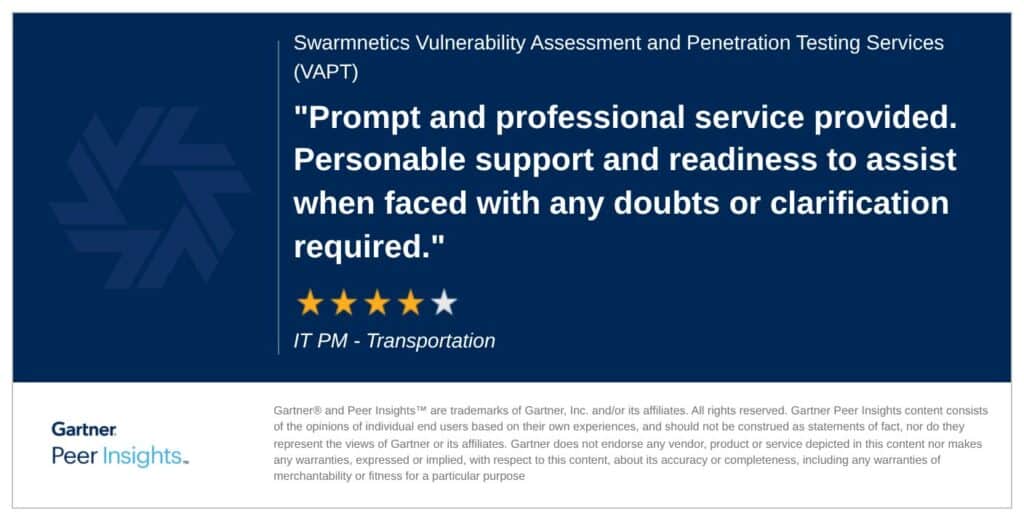
Gartner Peer Insight Review

Testing the binary, not just the backend and APIs

Because confidence demands proof, not promises

The assessment phase is where a mobile app VAPT diverges from web or API-only penetration testing.

Our Offensive Security Certified Professional (OSCP) and CREST Registered Penetration Tester (CRT) certified consultants begin with static analysis of the app binary. We use Mobile Security Framework (MobSF) for vulnerability scanning of the APK or IPA and for automated scanning of manifest configurations. We also use JADX to decompile the code. This analysis reveals hardcoded credentials, insecure storage patterns, debug flags in production builds, and security vulnerabilities in the application’s own code.

Dynamic analysis follows on rooted devices and emulators. We use Frida for runtime instrumentation and Burp Suite Professional to intercept and manipulate traffic between the mobile client and its backend web applications and APIs. We validate SSL certificate pinning by routing traffic through a controlled proxy. When certificate pinning is absent or weak, attackers may be able to perform a man in the middle MITM attack.

We use these tools in both black-box and grey-box mobile application security tests. That includes validating how the backend API handles requests originating from the mobile client, whether authentication and authorisation checks still hold when requests are altered, and whether client-side controls can be bypassed. That helps us identify vulnerabilities across the full client-to-backend scope, including issues that do not appear in standard server-side application security testing alone.

Yes, we are CREST accredited

Our core team is based in Singapore and consists of CREST certified penetration testers who are also Offensive Security Certified Professional (OSCP) certified. The team has delivered numerous penetration testing projects for customers in Singapore and other locations, from large multinational enterprises to small and medium business, and across various industries.

CREST Pentest

Inside the iOS and Android attack surface

Because confidence demands proof, not promises

A Swarmnetics mobile app VAPT tests the mobile client, its runtime behaviour, and the backend interactions it relies on across:

  • Insecure data storage: unencrypted databases, SharedPreferences, and iOS Keychain
  • Hardcoded credentials and API keys embedded in the binary
  • Absent or bypassable SSL certificate pinning enabling token interception
  • Improper platform usage, including exported Activities and insecure Content Providers
  • Client-side authentication bypass and broken session management
  • Missing binary protections such as obfuscation, tamper detection, or root detection
  • WebView misconfiguration enabling cross-site scripting and data leakage
  • Sensitive data in device logs, crash reports, and production debug output
  • SQL injection, broken authorisation, and other mobile application security flaws in backend APIs

FAQ

A web application penetration test evaluates server-side interfaces such as authentication flows, input handling, and API endpoints. A mobile app VAPT also decompiles the binary, tests local storage and inter-process communication on device, and validates SSL certificate pinning. Hardcoded credentials and missing binary protections sit in the mobile client, beyond the reach of web testing.

A mobile app VAPT covers the full iOS and Android attack surface, including local data storage, binary hardening, certificate pinning, inter-process communication, and WebView configuration. It also covers API authentication and authorisation on the backend. Swarmnetics maps findings against the OWASP Mobile Top 10 and OWASP MASVS.

A black-box mobile app VAPT tests what an attacker can exploit from the installed binary alone. A grey-box engagement adds test account access so the assessment can cover authenticated API flows, broken access control, and business logic flaws. Swarmnetics generally recommends grey-box testing for consumer and fintech applications because high-severity issues often sit behind the authenticated layer.

Absent certificate pinning can enable man-in-the-middle interception of credentials in transit. Insecure local storage can expose sensitive data from a compromised device without any network access. Hardcoded API keys can provide direct backend access and bypass authentication controls entirely. For regulated mobile applications, each of these outcomes can create direct exposure under MAS TRM 2021 and PDPA.

A mobile application penetration test from Swarmnetics produces a draft report for your review, followed by a final report upon acceptance. The report includes an executive summary, a detailed technical section with every finding listed by CVSS severity, proof-of-concept evidence demonstrating exploitability, and specific remediation guidance. After you have addressed the findings, we conduct a follow-up retest to confirm adequate remediation.

Any organisation that operates iOS or Android applications should consider a mobile application penetration test. It is particularly relevant for organisations subject to regulatory, contractual, or industry security requirements, which requires regular penetration testing of API endpoints. A mobile application penetration test is also recommended before launching new mobile application systems, after significant changes, and as part of an ongoing security assurance programme. Swarmnetics has conducted mobile application penetration tests across all sectors since 2015.

The duration of a mobile application penetration test depends on the scope – the number of applications and their APIs, their complexity, and whether a black-box or grey-box approach is used. A typical mobile application security assessment takes five to ten business days for the assessment phase, followed by an initial report within five business days for your review.

A mobile application penetration test is often required for compliance with applicable regulatory, contractual, or industry security obligations where organisations must demonstrate that mobile application security controls are effective through regular testing, not just scanning. Swarmnetics recommends conducting a mobile application penetration test at least annually, after significant changes, and before launching new mobile application systems into production.

Every mobile application penetration test follows a three-phase process. In the planning phase, Swarmnetics agrees the scope, testing approach, and schedule with your team. In the Assessment phase, our OSCP and CREST-certified consultants conduct manual mobile application security testing following the OWASP Mobile Security Testing Guide to identify and actively exploit vulnerabilities, determining their real-world impact. In the reporting phase, we deliver a draft report for review and a final report with detailed remediation guidance for every finding.

All Swarmnetics penetration tests are conducted by our Singapore-based team of security consultants holding the Offensive Security Certified Professional (OSCP) and CREST Registered Penetration Tester (CRT) credentials. Swarmnetics has been delivering technical security assessments to organisations across Singapore since 2015 and acts as a trusted VAPT delivery partner to service and solution providers, supporting their customers across multiple sectors.

The security assessment report includes specific, actionable remediation guidance for every finding – not generic advice. For each vulnerability, we describe the fix, its priority based on CVSS severity, and any dependencies between remediation steps. Once your team has addressed the findings, Swarmnetics conducts a follow-up retest to verify that each vulnerability has been adequately remediated. The final report confirms closure and provides documented evidence of remediation.